

Details
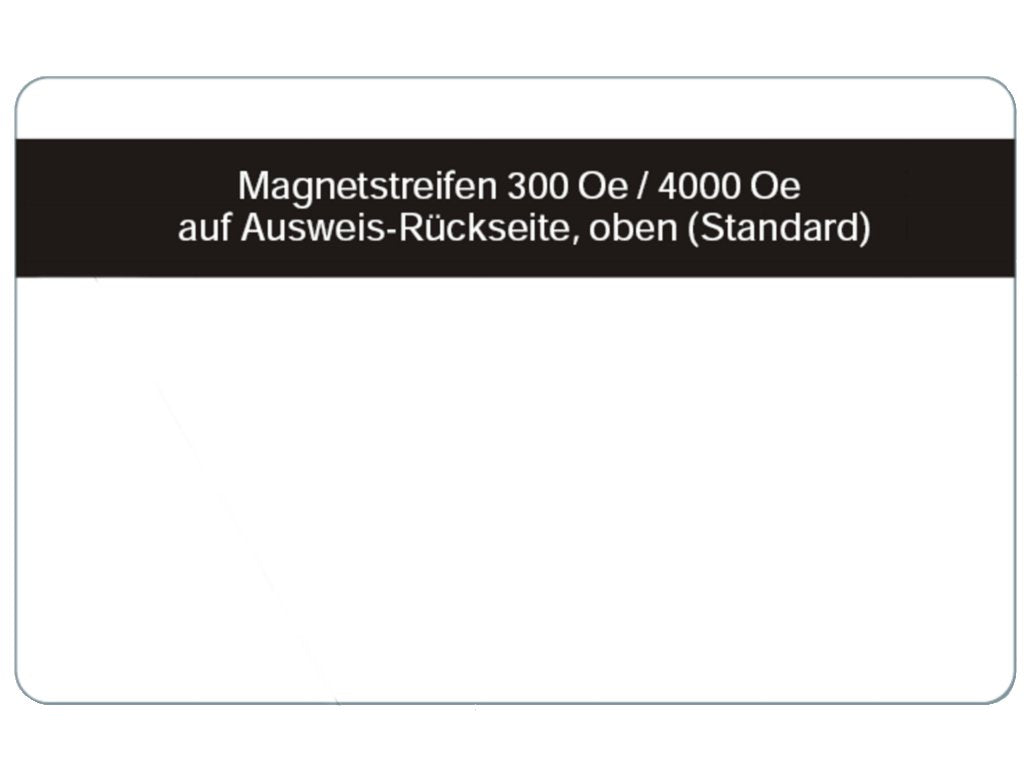
Usually, the magnetic stripe is placed on the back (cheque or credit card) of a card if its data needs to be read by a swipe reader. The disadvantage of this card is that the contained data can be easily changed.
Plastic cards with magnetic stripes are standardised according to the international standard ISO 7811.
There are 3 data tracks provided on the stripe.
- Track 1: 79 alphanumeric characters
- Track 2: 40 numeric characters
- Track 3: 107 numeric characters
These cards are divided into two different types: 4000 Oe (HiCo) and 300 Oe (LoCo).
LoCo cards are considered the standard. They are written with low energy, which means that the stored data can be destroyed or erased by strong magnetic fields.
HiCo cards are much more resistant due to better processing and are hardly erasable by external influences.
Areas of application: In combination with a PIN, magnetic stripe cards serve for the automatic identification of authorised persons.
Magnetic stripe cards were developed for the banking sector. However, due to the lack of security, the area of use has changed considerably.
Production is possible in the form of PVC, polyester and other plastics. Cards made of polyester are the most durable and promise a long service life. Both LoCo and HiCo are still very cost-effective and re-writable data carriers.
Material: PVC, white, high-gloss laminated
Design / Print: TTF printable
Coding: possible
Finish: burr-/scratch-free
Format: 86 x 54 x 0.76 cm